The Coperto Is a Cover Charge, and in Italy It Is Illegal in Rome but Lawful in Naples
The coperto on a Roman bill is prohibited by regional law. Three hours north in Florence the same charge is lawful. And the statute that consumer pages quote to prove the Roman ban was repealed seven years ago.

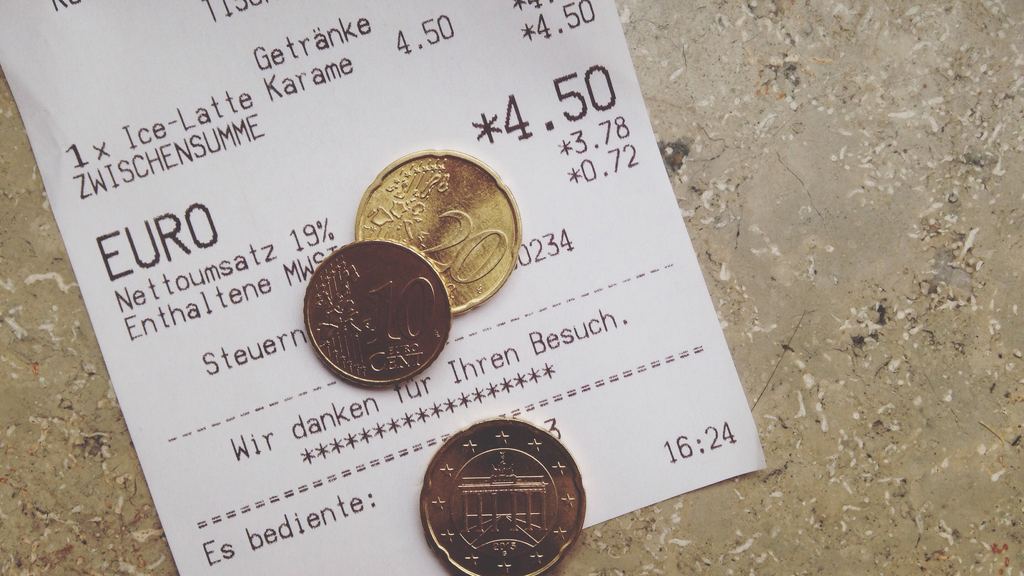
The coperto is the cover charge that appears on a restaurant bill in Italy: a flat sum per seated person, added whether or not you ate the bread it is meant to pay for. In Rome it is against the law.
Ask about it and the answer comes back the same way every time. It is normal here, everyone charges it. The first half is true. The second half is a legal question with three different answers inside one country, and the answer in Rome is the one almost nobody has.
There is a second problem, and it is the reason this piece exists. The statute that consumer pages, forum replies and one of our own research runs cite to prove the Roman ban was repealed seven years ago. People are quoting a dead law at waiters who are, in some cases, breaking a live one.
What a coperto is, and the two charges it gets mistaken for
Three things end up under the same complaint, and they are not governed the same way.
- A cover charge is a flat amount per person at the table. Coperto in Italy, couvert in Portugal, kouver in Greece. None of it necessarily reaches the person who served you.
- A service charge is a percentage the business adds. Disclosed before you order, it is part of the price.
- A tip is yours to decide, everywhere on this site.
Our guide to the bill, the cover charge and the tip lays that out across thirteen countries. This piece does something narrower. It follows one line down a bill through the six places where the rule is actually written down, and it ends on what you can do when the line turns up.
Lazio prohibits the cover charge, and the article number is the useful part
Lazio folded its commerce rules into a single regional act in 2019: Regional Law 22 of 6 November 2019, the region's consolidated commerce code. Article 75, fourth paragraph, forbids a business serving food at table from charging anything extra for the coperto. Not capped. Not conditional on being displayed. Forbidden.
The penalty sits somewhere else, which is why most pages that mention the ban never mention the consequence. It is at article 85, third paragraph, as an administrative fine on the business.
Two details are worth carrying, because both are what gets tested at a table.
The first is the date. It is 6 November 2019, and it is widely printed as 21 November. A wrong date is the quickest way to be told you have the wrong law.
The second is that the prohibition is about table service. A bar where you order at the counter, pay and carry your own coffee is not the situation the article addresses, and the standing-at-the-bar price in Italy is a different arrangement altogether.
The law everyone quotes has been dead for seven years
The Lazio ban did not begin in 2019. An earlier regional law, from 2006, carried a version of the same sentence, and that is the one the internet remembers. The 2019 consolidation repealed it.
That is more than a citation footnote, because the dead law is still circulating on pages with every reason to be right, consumer organisations included. When a research pass was run over traveller complaints for this site, it came back with the 2006 act marked as verified, carrying a working link to a regional archive. The source was real. The page loaded. The text said what the report said it said. The law had been off the books for seven years.
Nobody invented anything. The report found what the web repeats, and the web has been wrong since 2019. It is the same failure mode as twenty-two food stories put next to the paperwork: a confident claim, a plausible source, and no one checking whether the document still applies.
So if you are going to name an article at a table in Rome, name the one that is in force. Regional Law 22 of 2019, article 75. Citing the 2006 act hands the restaurant the only reply it needs, which is that the law you are quoting no longer exists.
What goes on the bill instead: bread, service, and the words that make it lawful
A ban on a word is not a ban on a charge, and the workaround is plain enough that you will meet it within a day of landing. The coperto comes off the bill and pane or servizio goes on.
Both can be entirely lawful. Bread is a product, and a service percentage is a component of the price. What makes either of them stick is disclosure: where there is table service the price list has to be available to you before you order, and the charge has to be on it. A line you meet for the first time at the end is a line you are entitled to query.
Bread has one further property, and it is the property the Portuguese rule turns into an explicit right. A basket that arrives unasked is an offer rather than a delivery, and you can send it back.

Tuscany bans it narrowly, Campania not at all
Three hours north of Rome the answer changes. Tuscany's commerce code, Regional Law 62 of 2018, prohibits extra charges for service and coperto at article 100, eighth paragraph, and it does so only on fixed-price offers. Order from the menu in Florence and a displayed coperto is lawful.
Campania is the honest gap in this article. We went through the region's commerce act of 2020 looking for the equivalent article and did not find one, which means that in Naples a priced and displayed coperto is lawful as far as we can establish. We did not read every article of it. That is an absence of evidence rather than evidence of absence, and we would rather write it that way than round it up into a rule.
Put the three together and the shape is awkward for anyone planning a week across Rome, Florence and Naples. The same charge, on the same kind of trattoria bill, is illegal in the first, conditional in the second and apparently fine in the third. Nothing on the bill tells you which one you are looking at.
Portugal: the couvert you can send back, and the olive that buys the lot
Portugal did not ban the couvert. It regulated it, and the result is the clearest rule here.
Decree-Law 10 of 2015, at article 135, requires the price list to carry everything that is for sale, the couvert included, and then says that nothing may be charged that the customer did not request or left untouched. Bread, olives, butter, a saucer of cheese: priced, offered, refusable.
Here is the part that tends not to get written down. The protection covers what you leave alone, and the plate is one item. Take a single olive and you have requested the saucer. If you do not want the couvert in Porto, say no as it lands, before anyone at the table has touched it.
The law protects what you leave untouched. One olive out of the dish is a request, and the whole couvert is then yours to pay for.

A priced offer, not a gift
The small plates that land before you have ordered anything are the couvert, and in Portugal they are stock with a price on it. The list has to say what that price is.
Which makes the refusal easy and the hesitation expensive. Nobody is going to be offended, and the only version of this that costs you money is the polite one where you pick at the olives while deciding whether to say something.
Spain and Greece: no cover charge, and a rule about what arrives anyway
Spanish law has no coperto to ban. What it has is a rule about the thing that actually happens. The consumer code, Royal Legislative Decree 1 of 2007, prohibits at article 66 quáter the supply of goods or services that were not requested where the supply carries a demand for payment, and it states that failing to respond is not consent. Bread you accept is bread you owe for. A dish that arrives unasked and then appears on the bill is a different matter, and the silence you kept while it sat there is not an agreement.
Greece prohibits the kouver outright, in a ministerial decision of 2017 on the marketing of products and services. Article 72 governs what a food service business may put on a bill. We are citing the article and not the paragraph deliberately: the paragraph numbering was never read on the government gazette itself, and a number we have not opened does not get published here.
| Where | The cover charge | What you cannot be made to pay for | The rule |
|---|---|---|---|
| Lazio (Rome) | Prohibited where there is table service | The coperto, in any amount | Regional Law 22 of 6 November 2019, art. 75 para. 4. Fine at art. 85 para. 3 |
| Tuscany (Florence) | Prohibited on fixed-price offers only | Service or coperto added to a set menu | Regional Law 62 of 2018, art. 100 para. 8 |
| Campania (Naples) | No regional ban found | Anything not on the price list before you order | Regional Law 7 of 2020, read in part. No equivalent article located |
| Portugal (Porto) | Lawful, priced, and refusable | A couvert you did not request, or left untouched | Decree-Law 10 of 2015, art. 135 |
| Spain (San Sebastián) | Not a standard charge | Food or drink supplied unrequested with a demand for payment | Royal Legislative Decree 1 of 2007, art. 66 quáter |
| Greece (Athens) | Prohibited | The kouver | Ministerial Decision 91354 of 2017, art. 72 |
How to query a coperto without making a scene
Most of the value here is before you sit down rather than after you have eaten.
The strongest move is the price list. Where there is table service you are entitled to see prices before you order, and that is the moment at which a coperto either exists or does not. Thirty seconds with the menu in Rome tells you whether the restaurant has decided to charge something its own region forbids.
If the line turns up at the end anyway, three things work and none of them requires a raised voice. Ask for the bill itemised rather than rounded to a total. Point at the line and ask what it is for. Name the law, if you have the right one: in Lazio, article 75.
And then the part this site will say and most will not. A coperto is a small sum, you are on holiday, and the person holding the card machine did not write the regional statute. Deciding it is not worth the argument is a legitimate outcome, and on most evenings it is the one we would pick. The reason to know the rule is not to win a confrontation over a couple of euros. It is to recognise, before you order, a place that has already worked out what it can get away with.
Timing is the other half of this, and it is the better early warning. A dining room serving a full menu at an hour when the rest of the street is shut is a dining room built for people who do not know when the city eats. Our guide to when thirteen countries sit down to eat predicts a disappointing dinner more reliably than any line on a bill.
Where these rules were read
Six instruments carry everything above, and they were read in their official texts when this site's reference file was compiled: Lazio Regional Law 22 of 6 November 2019, articles 75 and 85; Tuscan Regional Law 62 of 2018, articles 100 and 114; Campanian Regional Law 7 of 2020, in part; Portuguese Decree-Law 10 of 2015, article 135; Spanish Royal Legislative Decree 1 of 2007, article 66 quáter; and Greek Ministerial Decision 91354 of 2017, article 72, published in the government gazette.
One instrument is deliberately absent, and it is the one you will find everywhere else: the 2006 Lazio act. It is not a source for anything here, because it is not law.
The bill you never see
There is one version of a meal in Rome where none of this can happen to you, and it is worth naming because it is what this site sells.
Twenty experiences in the Rome food tours category, with a median price of €87 at current prices. Every one of them is paid for before you arrive. The charge this article is about is one you only ever meet eating on your own.
Being walked past the bill is part of what a food tour is really selling. In Rome a share of it is simply not having to read a price list in a language you do not have, at the end of a day when you are too tired to argue about two euros a head.
Four Rome walks where the bill is settled in advance
The four most reviewed experiences in our Rome food tours category, read on 21 October 2026. On a guided walk the tastings are inside the ticket, which is the one dependable way to meet none of the rules above.
A Wine Cellar 160 Years Older Than the Colosseum
From the Tiber island across Ponte Cestio into Trastevere: porchetta on white pizza, supplì, a sit-down pasta dinner with amatriciana and gricia, then gelato.

Thirty-Year Balsamic, and the Barolo Keeps Coming
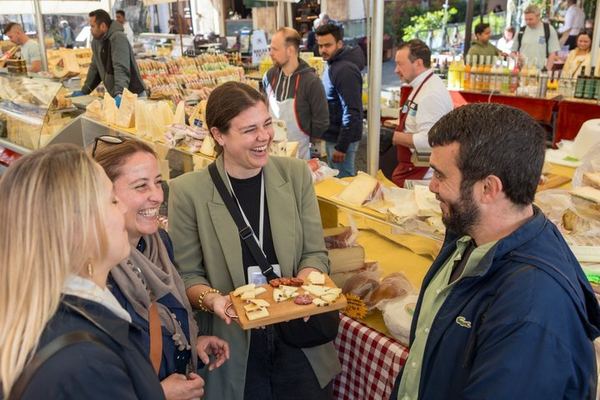
Five venues in Prati: Bonci's pizza, a shop with 400 cheeses, 30-year balsamic on 36-month Parmigiano, handmade pasta with free-flowing Barolo, then gelato.
From Giordano Bruno's Statue to a World-Champion Gelato
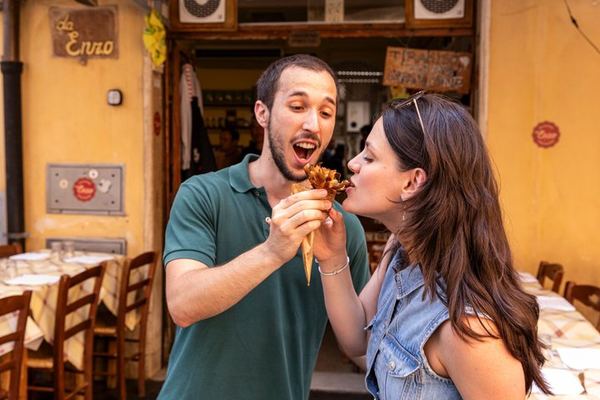
An 1890 norcineria, Rome's oldest bakery, artichokes by the Portico d'Ottavia, cacio e pepe in Trastevere and a 2020 gold-medal gelato. Twelve guests.
The Oldest Wood Oven in Trastevere, and the Wine Never Stops
Four hours and more than twenty tastings in four Trastevere rooms: handmade pasta, pizza from the neighbourhood's oldest wood oven, truffles, hams, gelato.
Ratings collected by Viator and Tripadvisor
The questions people actually type
Is the coperto legal in Rome?
No. Lazio's consolidated commerce code, Regional Law 22 of 6 November 2019, forbids a business serving food at table from charging extra for the coperto, at article 75, fourth paragraph. The penalty is an administrative fine on the business, at article 85, third paragraph. Be careful which law you name: an earlier Lazio act of 2006 carried a similar sentence and was repealed by the 2019 code, and it is still the one most consumer pages cite. Quoting the repealed one invites the answer that it no longer exists.
What is a coperto, and is it a tip?
A coperto is a flat charge per seated person, historically for the bread, the linen and the place setting. It is not a tip. None of it has to reach the person who served you, and leaving it does not discharge any obligation to tip, which in Italy is not expected in the first place. A service charge is a third thing again: a percentage added by the business, which forms part of the price once it has been disclosed before you order.
Can I refuse the bread in an Italian restaurant?
If it arrives without being ordered, yes. Bread that is put on the table unasked is an offer, and sending it back is reasonable. What you cannot do is eat it and then decline the charge, if that charge was on the price list before you ordered. In Lazio the useful move is different anyway: ask to see the prices before you sit down, which you are entitled to do where there is table service, and look for whether a coperto is listed at all.
Is the couvert in Portugal optional?
It is refusable rather than free. Article 135 of Decree-Law 10 of 2015 requires the couvert to be priced on the list, and prohibits charging for anything the customer did not request or left untouched. The practical catch is that the protection covers what is untouched and the plate is treated as one item, so a single olive out of the dish amounts to accepting it. Say no as it arrives, before anyone has started on it.
Is the coperto banned everywhere in Italy?
No, and this is the part that surprises people. There is no national rule. Retail and hospitality are regional competences, and the regions have gone different ways. Lazio bans the charge outright. Tuscany bans it only on fixed-price offers, at article 100, eighth paragraph, of Regional Law 62 of 2018, so a displayed coperto in Florence is lawful if you ordered from the menu. We looked through Campania's commerce act of 2020 and found no equivalent article, which suggests Naples is unrestricted, though we did not read all of it.
What is the difference between coperto and servizio on an Italian bill?
The coperto is a fixed amount per person. The servizio is a percentage of what you spent. In Lazio that distinction has a consequence: the ban is written about the coperto, so a restaurant that wants the same money can rename the line as bread or as service, and both of those can be lawful if they appeared on the price list before you ordered. The test to apply is not the word on the bill. It is whether you could have known about the charge in advance.
The same bill, in thirteen countries
Where the cover charge is prohibited, where the service charge is a trade habit rather than a rule, and the one country whose law makes the waiter ask you about the tip.
Data verified on . Statutes read in their official texts for this site's source file; the Greek paragraph numbering was not read on the gazette. Catalogue prices read 21 October 2026.